
by Grace Brown
“The Advice Trap: We keep giving advice even though it doesn’t work that well.”
This summer the Edu Coach Network Summer Book Club read The Advice Trap by Michael Bungay Stanier, and we had the chance to confront our Advice Monsters. Our purpose in creating this book club was to provide a way for coaches to stay connected throughout the summer months and learn new strategies to take into the school year. Coaching often feels isolating, so it was a refreshing change of pace to learn and share with other professionals navigating similar challenges. Personally, I had my feelings hurt in the best way. Reading Stanier’s book felt like a bootcamp for my inner-critic, whipping the long-held narratives I’ve formed into shape. I’ve worked in education for close to 15 years (wow- when did that happen?!), and in that time, I’ve learned how to be the fixer.
Students don’t know how to use a comma? I can fix that.
A student needs help revising their paper? I can fix that.
The department needs someone to re-write the curriculum? I can fix that.
The track team needs another assistant coach? I can fix that.
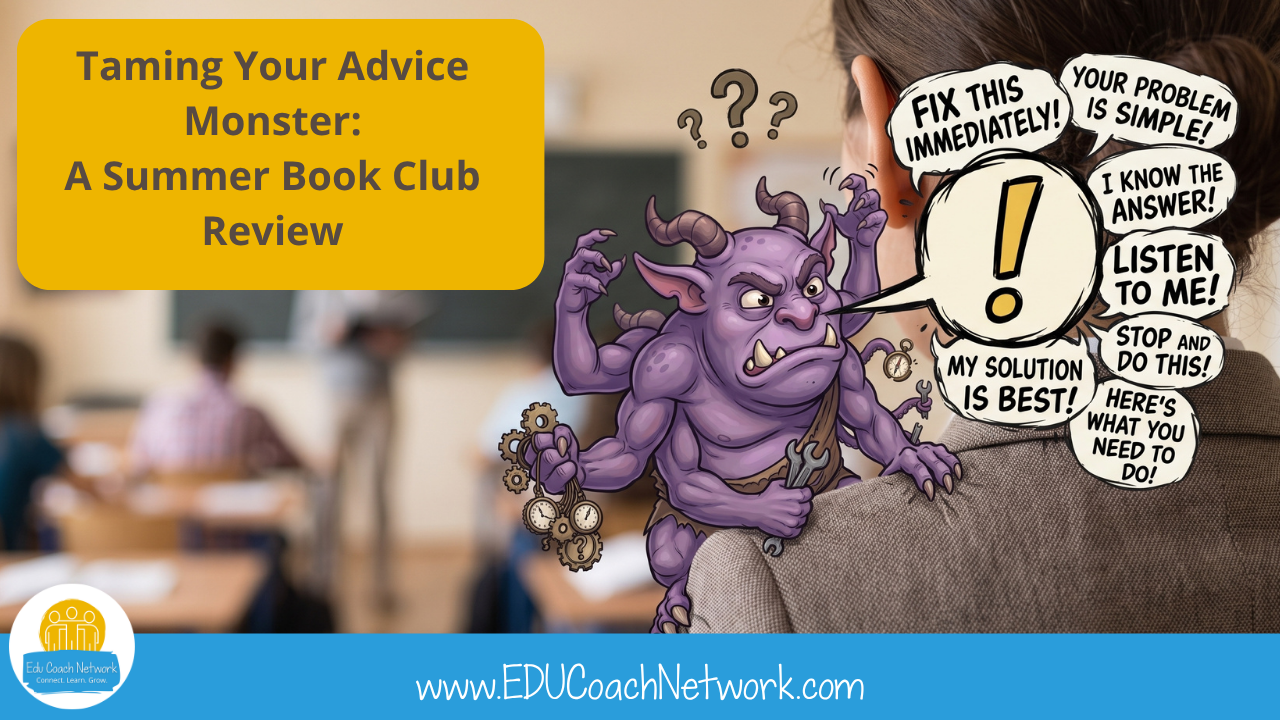
You get the picture. In education, we operate by having the answers and fixing the problems. If we don’t, the system will completely break down…right? Thinking like this has fed my Control-It Advice Monster, the gremlin in my brain that says all I have to do is control all the pieces and everything will be fine. Stanier identifies three main Advice Monsters: Tell-It, Save-It, and Control-It. These monsters are well-intended (most of the time) but they end up getting in the way of our ability to lead others authentically. You may not have the same Advice Monster as me, but I bet you’re recognizing your own gremlin voice that pipes up when there’s a problem to be solved.
In our first Book Club discussion, we were all pushed into a vulnerable place of identifying which Monster is ruling our coaching practice. Talk about diving into the deep end! It was a tough moment because we all have good intentions when we give advice. We want to help! I mean- it’s literally what we are there to do. So challenging our Advice Monster feels like challenging our very role. One participant, Melissa Glanden said, “My whole educational role as a librarian or anything has been save it, control it…the hard change is…well, what would that look like?” If we pause, if we don’t have the answers, if we can’t jump in with the “right answer,” what are we doing?
The Four Coaching Principles
Thankfully, Stanier doesn’t just help us identify our Advice Monsters, but he also provides valuable frameworks to restructure our coaching practice and lead with curiosity. He shares his Four Coaching Principles:
- Be Humble: Realize you don’t have the full picture.
- Be Curious: Stay in the question longer than you think you should.
- Be Lazy: Let the other person do the thinking.
- Be Often: Coaching isn’t a formal event; it’s a way of interacting every day.
You can imagine how “Be Lazy” went over on a call full of coaches. Each of us shared how this struck a deep chord within us, and as a group, we grappled with what it would look like for us to “be lazy.” In our discussion, Torie Mollett offered a reframe on the phrase. She said, “Maybe ‘be lazy’ is also ‘be patient.’” Torie took Stanier’s principle as permission to sit in the silence of a conversation and not feel responsible for filling the gaps. In creating that space, we create an opportunity for teachers to process their thoughts in a safe environment. Another coach, Kathleen Van Alst built on that point saying, “I really had to rethink how that [Be Lazy] would have meaning for me. And it really was using the word ‘empower’ and building self-efficacy for the teacher.” When we resist the temptation to fix everything, when we create space for silence, we aren’t shirking our responsibility as a coach; we are inviting others to exercise their own power and expertise.
I had never read a book on coaching before, so I went into leading this book club with major reservations. I wasn’t interested in reading some guru’s word salad manifesto, and I really didn’t want to have to lead others through that either. Thankfully, my pre-conceived notions were wrong. Not only will this book become a staple in my practice, but the conversations we had as a group will stick with me for a long time. Coaching can be weird, and hard, and isolating, and overwhelming, and I am so grateful I had a chance to sit in vulnerable conversations with other people who get all that.
Next Steps
If you haven’t yet read this book, I highly recommend it! Be prepared to ask yourself tough questions and walk away with a new perspective on coaching. And if you can read it in the company of your peers, even better! I’m already thinking about our next book club, so make sure you’re signed up for the newsletter and follow us on socials to stay up to date with all upcoming events like this!
💾 Want more?
📚 Read
- Plating Up Success: Using the COACH Framework to Simplify Goal Setting
- The Data Engine: Using Ai to Fuel Smarter Coaching Conversations
🔊 Listen to The EDU Coach Collective (Formerly Restart Recharge) podcast
🎬 Watch (EDU Coach Network All-Access Members only)
- Webinar: 3 Methods for Organizing Coaching Conversations and Workflows
- Webinar: 3 Strategies for Forming Authentic Connections with Teachers this Year

