
by Emily Cowan
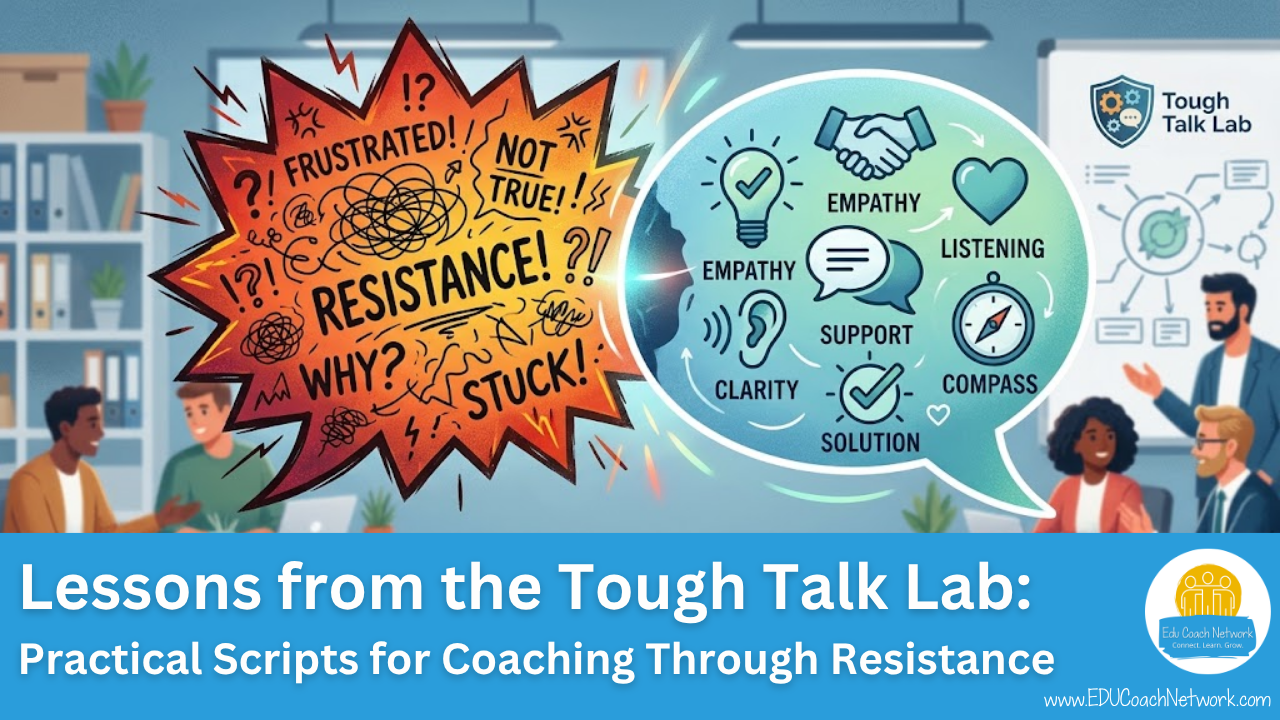
We had a blast running our recent Tough Talk Lab with the EDU Coach Network Live Event on September 23rd. I put on my (not so good) acting hat to play that skeptical veteran teacher, dialing up the resistance while my colleague Grace stepped into the coach’s seat. Grace masterfully navigated the push back using active listening. She was repeating back what she heard, grounding her responses with "yes... and/but", and asking strategic questions to establish context. The initial goal was simple: help coaches walk away with snappy, practical statements they could pull out when real-world conversations get tricky.
But right in the middle of my stubborn interaction, Grace paused and asked a question that stopped me in my tracks:
"Am I required to work with you? What's our background here? Because honestly... if a teacher responded to me like this in real life, I would have gracefully exited this conversation a long time ago."
Cue the record scratch. That was a massive light bulb moment.💡
I had spent so much time preparing for the "tough talk" and my acting that we forgot to address the context around why and when we have these conversations in the first place.
As coaches, we don't need to spend an exorbitant amount of energy trying to kick down the door of a wildly resistant teacher who doesn't want us there. Our energy is far better spent on the teachers who do want help… even if they don't fully understand how we can support them yet, or if they’ve forgotten that real student learning is the basis behind everything we do.
So, how do we handle those awkward, real-world moments with teachers, leadership, and other stakeholders without losing our sanity or our purpose? Let's break down three real scenarios and how to navigate them.
The "Fun, High-Energy Activity" (That Lacks an Instructional Goal)
The Scenario: A teacher comes to you buzzing with excitement about a flashy, hands-on activity. They want to get students moving, creating, and using new spaces, but when you look at the plan, there’s no learning outcome in sight.
I experienced this firsthand with a high school teacher who was thrilled to get her class into the maker space for a novel study. Her vision? Half the class would build a physical model of the setting, and the other half would build models of the characters.
When we sat down to plan, I asked a few digging questions to understand the logic. Why were certain students doing settings while others did characters? What was the core takeaway from the novel they were proving through this experience?
Crickets. She hadn't looked at the standards or considered the "why", she just wanted a fun, hands-on product that would get her students into the makerspace for a multi-day workshop. Interestingly enough, the maker space coordinator was sitting in on our planning session, initially all-in on the craft ideas. But as I gently pushed back to uncover the instructional purpose, the coordinator got a front-row seat to what instructional coaching actually looks like. I think this was an important moment for all three of us.
The Pivot Strategy
What we don’t want to do in this scenario is kill the energy. We want to redirect it. Validate their enthusiasm for student engagement, but anchor it back to purpose:
"I love how hands-on this idea is, and the students are going to be so excited to get into that space! To help us figure out how to grade this, what is the #1 standard or core understanding you want them to prove through these models? Let's start there so we can build a quick, clear rubric."
The "Way Too Advanced" (or Repetitive) PD Request from Admin
The Scenario: An administrator comes to you excited about a brand-new PD initiative… maybe they want everyone to fully implement advanced project-based learning by next month, or they want a session on an initiative staff have already sat through three times before. You know instantly that teachers are either going to feel completely overwhelmed or immediately check out because it doesn't meet them where they actually are.
When admin pushes for something out of reach or redundant, the best tool you have is intentional questioning grounded in andragogy (how adults learn). Adults need immediate relevance, and they need to see how learning directly connects to their current daily reality. Your job isn't to say "no" to your principal—it's to use questions to gently anchor their big vision back to what teachers can realistically digest and apply right now.
The Questioning Strategy
Bring the conversation back to the purpose and current teacher capacity. Use questions to help admin see the gap between their vision and staff readiness:
"I love the long-term vision behind this! To make sure this really lands well and doesn't overwhelm everyone right now, what is the single most important action we want teachers to take in their classrooms next week? Given where staff are at with [current initiative/workload], what if we bridge the gap by focusing this session on [foundational skill/practical bite-sized step] first? That way, we meet them where they are and build momentum toward that bigger goal."
The "Can You Just Staple These Packets?" Favor
The Scenario: It’s two hours before Open House or the start of a busy week. A department head or team lead runs up, stressed out, and asks if you can help staple 200 packets because they ran out of time.
It is so hard not to be a "yes" person. We want to be helpful, and we want teachers to like us. But every hour spent on manual assembly is an hour stolen from classroom support, co-planning, and data cycles.
The "Exchange & Elevate" Strategy
If you have the time and genuinely want to help in the moment, don't just do the task quietly—use it as a bridge to show them what your real role is:
"I can definitely jump in and help you wrap these packets up today since I have a free block! But hey, while we're working on this, let's grab 10 minutes next week to talk about your next unit. I’d love to trade some prep time for an instructional goal we can work on together so you feel less buried next time around."
The Big Takeaway
Having "tough talks" isn't about winning arguments or dragging reluctant colleagues kicking and screaming into coaching cycles. It’s about gently holding the line for instructional purposes, keeping adult learning principles at the center of your work, and setting boundaries that protect your true role as a coach.
Next Steps
I'd love to hear from you: What is your go-to phrase when a conversation starts sliding away from learning goals and into "busy work"? Do you find it harder to set boundaries with teachers, team leads, or admin? Drop your thoughts in the comments below!
💾 Want more?
📚 Read
- The Power of Psychological Safety in Coaching
- Finding Your Voice: "Coach Nice" to "Coach Candid"
- Beyond the Brick Wall: Opportunity vs Obstacle Thinking
🔊 Listen to The Listen to The EDU Coach Collective (formerly Restart, Recharge) Podcast
🎬 Watch (EDU Coach Network All-Access Members only)
- Connecting, Organizing, and Thriving: A Coach's Guide to Success in a Complex Environment
- Webinar: 3 Methods for Organizing Coaching Conversations and Workflows

